Rates 2026/27
District Rate 2026-2027
Fermanagh and Omagh District Council has agreed a District Rate increase of 1.96% for domestic (residential) and non-domestic (business) properties for 2026-2027. This represents:
- An increase of £10 per year for the average domestic (residential) property with a capital value of £115,000
- An increase of £26 per year for non-domestic (business) properties with an average net annual value of £5,000
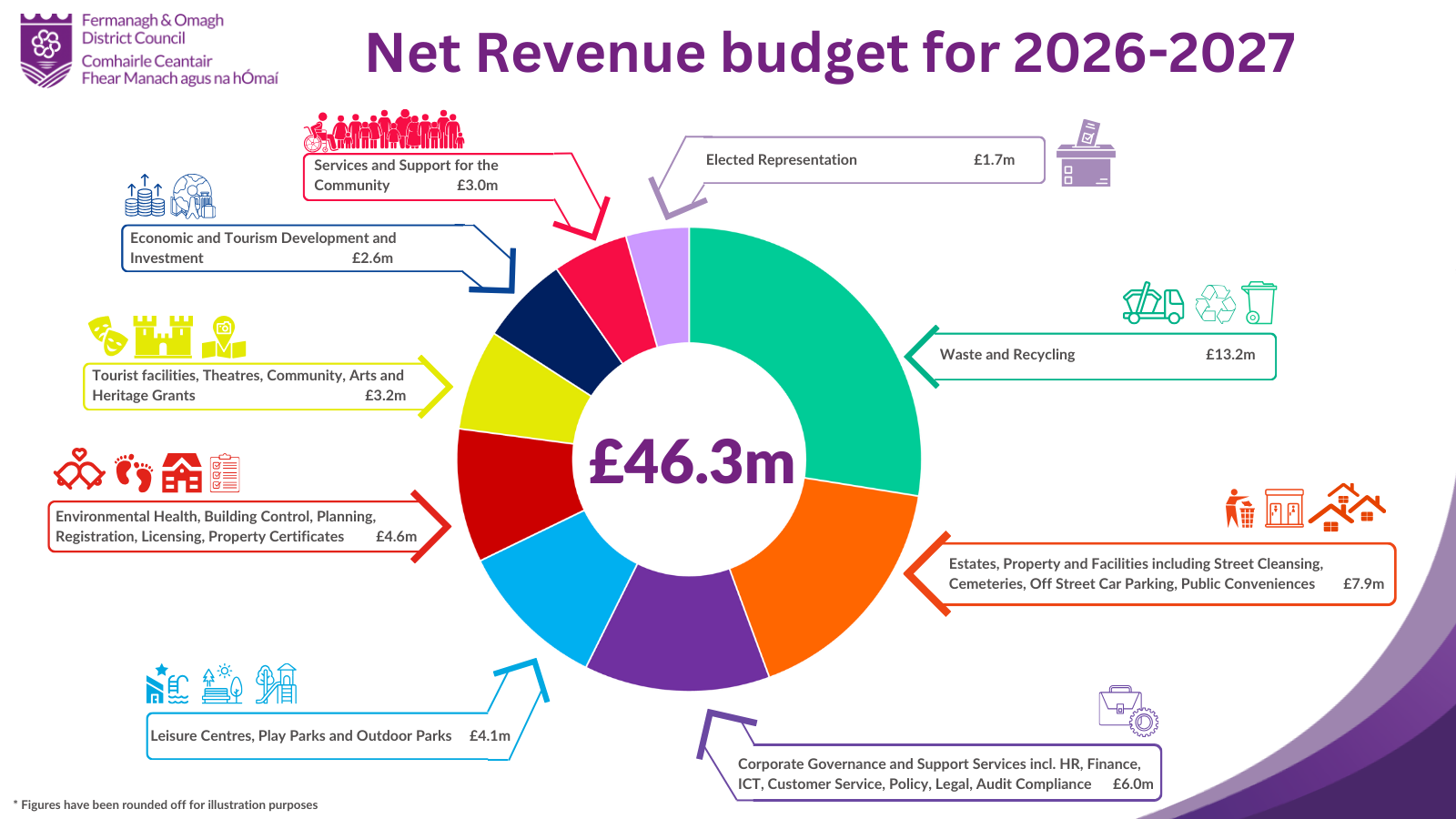
Net revenue budget 2026-2027
The setting of the District Rate will enable the Council to deliver a range of key services across the Fermanagh and Omagh District in 2026-2027 and meet the Council’s priorities as set out in the Fermanagh and Omagh Community Plan 2030 and the Council’s Corporate Plan.
The net revenue budget for 2026-2027 is £46.3m
Capital Programme
The Council plans for an ambitious £34.6m capital investment programme in 2026-2027 to improve local infrastructure and facilities for the benefit of all. The Council has secured £13.5m in external funding to support the programme, reducing the overall cost to ratepayers.
The proposed capital projects include:
- Redevelopment of Fermanagh Lakeland Forum
- Waste Management projects
- Peace Plus Projects and Local Peace Plan
- Mid South West Projects
- Town Centre Regeneration – Enniskillen & Omagh
- Play Area refurbishment
- Strategic Capital Grants programme for local communitie
How we use your rates 2026-2027
45% of your total rates bill is paid to Fermanagh and Omagh District Council to pay for the delivery of key services across the Fermanagh and Omagh district and a capital programme to improve local facilities and infrastructure. The remaining 55% is paid to Central Government.
A ‘How we use your rates’ online tool is available on the Council website to see how much of your rates is used to fund local Council services.
Frequently Asked Questions
1. How much will my rates increase by in 2026/27?
In 2026/27 the District Rate will increase by 1.96% for both residential and business properties. This is a below inflationary increase.
The District Rate (set by Council) and the Regional Rate (set by the Northern Ireland Executive) are combined and multiplied by the rateable value of your property to determine your rates bill.
You can work out your total rates bill by using the Department of Finance’s online property valuation tool.
2. What did the Council consider when setting the District Rate?
Like residents and businesses, the Council is also experiencing the same ongoing cost pressures linked to current external market conditions and an uncertain economic environment.
The Council continues to manage its finances prudently. To help minimise the financial impact on ratepayers and support long‑term financial sustainability the Council continues to ensure services are delivered at optimum value to the ratepayer and pursues external funding opportunities.
The setting of the District Rate will enable the Council to continue to deliver core and statutory services and provide a range of supports to communities and businesses. It will also enable investment in our communities through the delivery of a £34.6m Capital Programme (with 39% of this attracting external funding).
3.How does the Council’s investment on new facilities and infrastructure impact my rates?
Any element of the capital plan that does not receive external funding, or funding has not been previously set aside in Council reserves, requires capital borrowing. The cost of the annual borrowing repayments is included within the Council’s overall amount to be raised from rates. The Council will not require any new external borrowing to fund the 2026/27 capital plan.
4. How much money will be generated for the Council by the 2026/27 rates bill?
It is estimated that £46.98 million will be raised through the rates in the 2026/27 financial year.
5. Who sets the rates?
The District Rate is set by the Council. It is approved by the Councillors at a Special Council Meeting in February each year. Councillors, with assistance from Council Officers, review the budgets for service delivery and the capital programme, as well as income received from the District Rate and other sources, to agree the District Rate.
The Regional Rate is set by the Northern Ireland Executive. The Council has no input to this process.
6.How are the rates calculated?
The District Rate and the Regional Rate are combined and multiplied by the rateable value of your property to determine your rates bill.
You can work out your total rates bill by using the Department of Finance’s online property valuation tool.
7. Does the Council receive the full amount of money paid through the rates?
No. The Council receives approximately 45% of the income raised through the overall rates bill. The remaining 55% is paid to Central Government.
The allocation of rates to the Council is determined by the increase in the District Rate, agreed by the Council on an annual basis.
8. Why is there a District Rate and a Regional Rate? What are they used for?
The District Rate is set by the Council in February each year to pay for the delivery of local core and statutory services i.e. services it is legally required to deliver, as well as a capital programme to improve facilities and infrastructure across the District.
Core and statutory services include:
– Waste collection and disposal
– Environmental Health (including Food Control, Health & Safety, Consumer Protection, Environmental Protection, Public Health, Housing, Planning and Health Improvement)
– Registration of births, deaths, marriages and civil partnerships
– Planning
– Building Control
– Cemeteries
The Council also provides a number of additional services for the benefit of residents and businesses and to enhance the District. These services include:
- Leisure and recreation facilities
- Parks and play parks
- Community events
- Arts, cultural, heritage and tourist facilities
- Household Recycling Centres
- Street cleansing
- Public conveniences
- Off Street Car Parking (car parks)
- Economic and tourism development
- Community support services including grant funding
- Capital projects and capital grants, supporting investment in our communities.
A ‘How we use your rates’ online tool is available on the Council website. Here you can enter your total rates value for the year to see the exact contribution you make to the Council to fund local services.
The Regional Rate is set by the Northern Ireland Executive to contribute to the delivery of services including:
– Roads
– Education
– Health
– Emergency services
– Law and order
– Social services
The Council has no input in the Regional Rate process.
9. How does the Council decide on its priorities for expenditure from the rates it receives?
The Council’s priorities are set out in the Fermanagh and Omagh Community Plan 2030 and the Council’s Corporate Plan.
Councillors prioritise expenditure on the delivery of core and statutory services which it is legally required to deliver such as Waste collection and disposal; Registration of births, deaths, marriages and civil partnerships; Environmental Health; Planning; Building Control and Cemeteries, as well as a range of additional services and investment projects to improve the whole District, strengthen local communities and enhance the wellbeing of residents.
10. Can the Council address issues such as the maintenance of roads, pavements and grass verges and health care?
No. The Council is not responsible for roads infrastructure or health. These are the responsibility of Central Government departments. The Department for Infrastructure is the responsible body for roads, pavements and grass verges. The Department of Health is the responsible body for health care services.
11. Why does the District Rate vary between each Council?
Each Council sets its own District Rate, depending on its priorities. The legislative date for ‘striking’ the District Rate is by 15 February each year.
12. Can the Council use money from its reserves, or any surplus from the previous year’s budget, to offset an increase in the District Rate?
Council’s reserves have been established under relevant legislation to fund future specific expenditure. The Council has and continues to use available reserves to minimise the impact on ratepayers. The Council is using the final £0.5m from the Covid reserve balance in the 2026/27 budget to do this.
The Council also considers its actual financial position compared to its budgeted position on an annual basis. It then determines the allocation of any surplus to its usable reserves, in line with the Council’s Financial Reserves Policy.
13. Who has to pay rates and what happens if I cannot afford to pay my rates?
Domestic (residential) rates bills are issued by Land and Property Services to all residential properties in Northern Ireland. Land and Property Services has rates reliefs available for some homeowners who are entitled to help with paying rates. You can find out more about this on the nidirect website.
Non-domestic (business) rates are required to be paid on business properties, unless they are registered for charitable or religious purposes. Land and Property Services has a number of reliefs available to business ratepayers. You can find out more about this on the Department for Finance website.
14. I am renting my accommodation, who is responsible for paying the rates bill?
The owner of a rental property is responsible for paying the rates bill.
15. When do I receive my rates bill and how can I make payment?
Land and Property Services generally issue rates bills in April each year. It is also responsible for collecting rates monies. Payment can be made in one lump sum or by direct debit over 10 months. Information on how and when to pay your rates as well as support which is available is detailed on your rates bill.
16. I have a query about my rates bill, who do I contact?
Rates are managed by Land and Property Services, therefore, if you have a query you should contact them on 0300 200 7801 or visit the NIDirect website.
17. Where can I find out more?
For further information about rates and rates relief for householders and businesses, please contact Land and Property Services by calling 0300 200 7801 or visit the Land and Property Services website
Further Information
For further information about rates, including valuations of properties and rates relief for householders and businesses, please contact Land and Property Services by calling 0300 200 7801 or visit the nidirect website.
The Department for Communities – General Estimates of Rates 2026-2027 is available to download.